
Choosing between natural stone and quartz countertops is less about finding the better material and more about finding the right fit for your kitchen. Both belong in high-end kitchens, and the answer comes from three things: the color, finish and pattern of the cabinetry; how the room is used; and how much care you want the surface to ask for. High end kitchen countertops are also judged by the island they sit on and the fronts beside them, not by the slab alone. This guide covers the materials first, then three Bay Area kitchens that took different routes.
Quartz vs. Natural Stone: What’s the Difference?
Here is a quick overview. The sections that follow explain each point in more detail.
| Material | Appearance | Daily Use & Durability | Maintenance |
| Engineered quartz (manufactured) | Consistent color and pattern, in a wide range. | Nonporous. Makers advise a trivet for hot cookware. | Cambria says no routine sealing. Mild soap and water. |
| Marble (natural) | Distinctive veining that varies slab to slab. | Soft calcite. Acids such as lemon juice can etch the surface. | Sealing slows staining but does not prevent etching. |
| Granite (natural) | Color and pattern vary widely by stone and slab. | Hard, with excellent scratch resistance. Not sensitive to most household acids. | Most granites benefit from sealing. Schedule varies. |
| Quartzite (natural, not engineered quartz) | Natural stone that can resemble marble. Varies by slab. | Hard. Genuine quartzite does not etch from kitchen acids. | Porosity varies, so some need sealing. Confirm it is true quartzite. |
Heat guidance varies by product and stone.
Engineered quartz is a manufactured slab, made of crushed quartz bound with resin and pigment. Quartzite is a natural rock. It is a metamorphic stone that began as sandstone and is made almost entirely of the mineral quartz, according to the Use Natural Stone quartzite guide. The two share a mineral and little else. One is made to a design. The other is quarried as it formed.
Marble and granite are the other natural stones most often considered. Marble is calcite. Granite is a coarse-grained igneous rock made of minerals including feldspar and quartz. They behave differently enough that the name of the stone tells you more than the phrase “natural stone,” and the durability and maintenance section below compares them.
How Quartz and Natural Stone Look Beside Your Cabinetry
Natural stone is individual. Veining, flecks and movement change across a slab and between slabs. On a long island, aligned or bookmatched slabs can make the pattern a focal point. The trade-off is surprise: a small sample shows you the type of stone, not your slab, so choose from the actual slabs or detailed images of them.
Quartz is designed, so color and pattern are consistent across a wide range, from soft whites and greys to deeper tones, some with fine marble-inspired veining. Manufacturers still note small differences from sample to slab. Caesarstone, for one, encourages viewing a full slab before purchase.
With custom Italian cabinetry, choose the countertop and the cabinet finish together, from real samples side by side, in the light of the room. Finish works best when it is settled early, together with layout, lighting and countertops, as we explain in our guide to choosing a cabinet finish. Lighting matters here too. A polished surface tends to reflect pendant and under-cabinet light, while a honed or matte one reads softer, so the same slab can look different from one kitchen to the next.
Stosa Cucine‘s Natural collection offers plain, slatted or reeded veneered wood doors, and its Color Trend collection offers gloss or matte lacquered doors in a wide range of colors. A veneer door brings its own grain to the room, so a quieter countertop beside it often lets the wood lead. A lacquered door in a single color can give a veined quartz or stone more room to be noticed. Stosa’s Aliant collection goes a step further and brings stone-like material into the cabinetry itself, combining glass, HPL and Neolith, which our site describes as a man-made stone.
Does Quartz Look Less Premium Than Natural Stone?
No, engineered quartz is not inherently less premium than natural stone, and neither material guarantees a high-end result. That comes from the surface and finish you choose, how it works with the cabinetry, the fabrication details and the design as a whole. Natural stone offers variation from slab to slab and quartz offers greater visual consistency, and either quality can be what a kitchen needs.
Quartz’s consistency is a design tool. Handleless, flat-fronted cabinetry in a solid color or a strong wood grain often pairs well with a surface that stays calm, and a fine-veined quartz or a quiet stone can do that.
Where the cabinetry is plain and the surface is meant to carry the room, a bold marble or quartzite can take that role. Pattern beside pattern needs care, since heavy veining running across an island can compete with a strongly grained door.
A well-chosen quartz can suit a restrained kitchen better than a busy stone, and a dramatic stone can be the wrong fit where the kitchen already has plenty going on.
Quartz and Natural Stone in Three Bay Area Kitchens
Three Silicon Valley kitchens from our portfolio, in Sunnyvale, Los Altos and Mountain View, take three different routes.
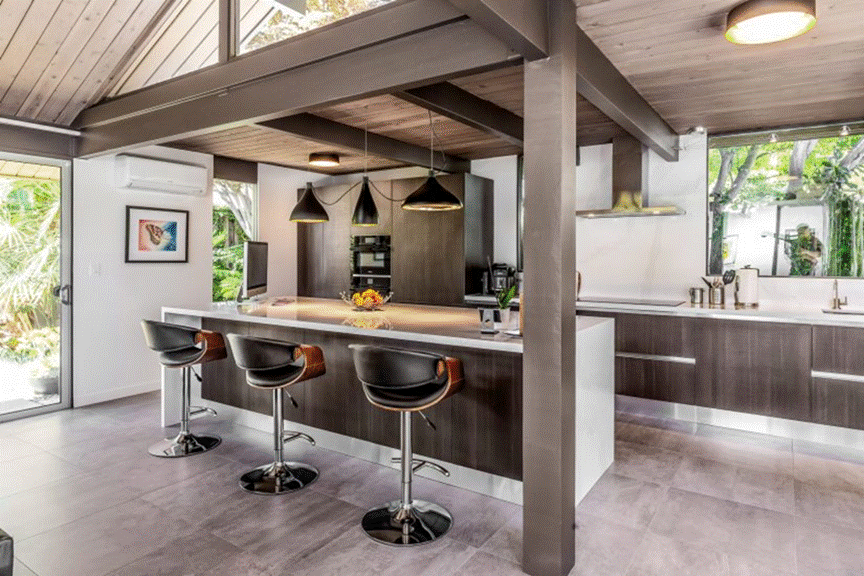
Sunnyvale Eichler remodel. The project page lists a Silestone quartz countertop in Et. Calacatta Gold and says the remodel was done with Miracle Builders Group and Bay StoneWorks. Visually, the cabinet fronts read as dark wood grain under an exposed-beam wood ceiling, and the countertop reads as a soft white with faint veining. That brings light against the dark cabinetry and leaves the wood grain as the main texture. The island top continues down its end as a waterfall panel, with a deep overhang for seating.
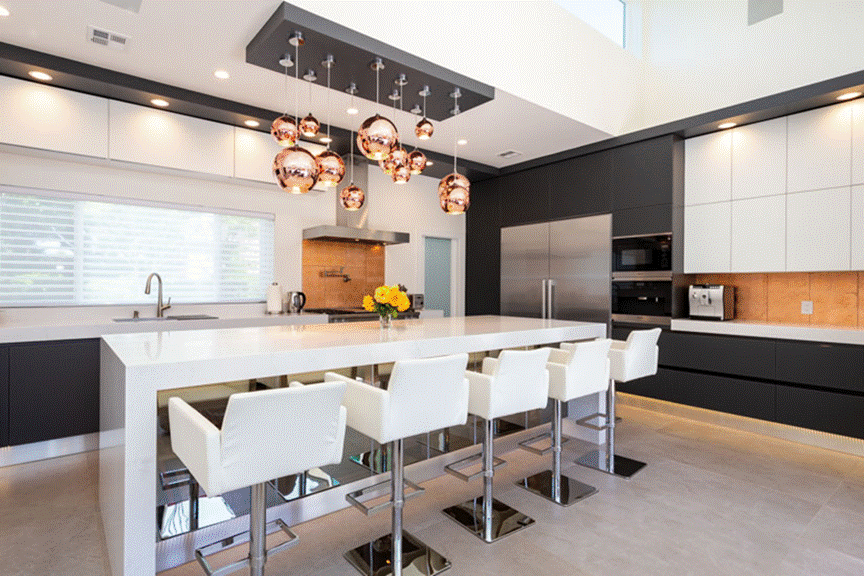
Los Altos black and white kitchen. The project page lists matte glass cabinets with white upper cabinets, a large island with a white granite top fabricated by Bay StoneWorks and large drawers on the working side, a bronze glass tile backsplash and bronze lamps over the island. Visually, the base cabinets read as charcoal, and the island top is a pale surface with fine grey veining, a thick edge and a waterfall end. It leaves the bronze tile and pendants to carry the color. Stools line one side of the island.
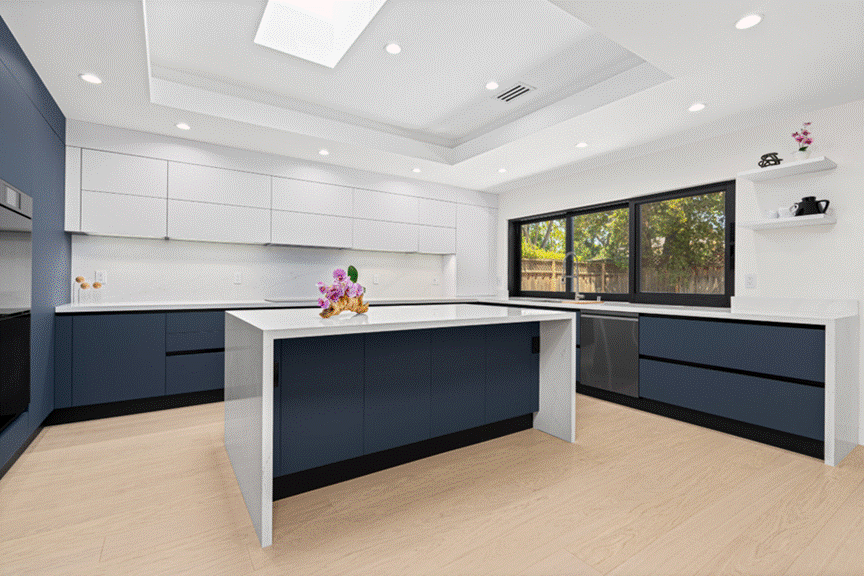
Mountain View blue kitchen. The project page describes white and blue cabinetry, white marble countertops and a waterfall island. Visually, the base and tall cabinets read as matte blue with white uppers, and a white, finely veined surface also rises up the wall behind the cooktop and wraps the island’s end panels, so the pattern reads as continuous from top to side. The blue does the color work, and the white surface stays quiet.
Quartz vs. Natural Stone: Durability, Maintenance and Daily Use
Product lines differ, so read this as the general pattern and check the specific surface.
Engineered quartz
Quartz manufacturers describe their surfaces as nonporous. Cambria states its quartz never needs routine sealing, and Caesarstone describes its surfaces as nonporous and virtually maintenance-free. Both advise a trivet or hot pad for hot cookware. Caesarstone also lists cleaners to avoid, including oil soaps, oven cleaners and cleaners made for granite or marble. Read the care guide and warranty for the line you choose.
Do marble countertops stain or etch, and is the upkeep worth it?
Marble is calcite, a soft mineral that reacts to acids. Lemon juice, vinegar or wine can leave dull etched marks, and sealing does not prevent that, according to Use Natural Stone’s marble guide. The same guide says marble is less prone to staining than commonly believed. Etches can be polished out or left to become part of the surface, and dolomitic marbles etch a little more slowly.
Whether the upkeep is worth it comes down to preference. Some owners welcome a surface that records its use, and others would rather avoid it. That preference is a fair reason to choose marble or rule it out.
Granite
The Natural Stone Institute describes granite as one of the hardest dimension stones, with excellent scratch resistance. Its reported absorption rates are low, 0.05 to 0.40 percent by weight. Use Natural Stone says most granites still benefit from sealing, though some may not need it and the schedule depends on the stone and sealer. Granite is not sensitive to most common household acids. Granites vary widely, so ask the fabricator about the specific slab.
Is Quartzite a Good Marble Alternative, and How Can You Tell It Is Real?
It can be, where the look of a veined natural stone is wanted with less concern about etching. Use Natural Stone notes that marble and quartzite can look very similar, and says genuine quartzite will not etch from kitchen acids such as lemon juice or vinegar. The mineral quartz rates 7 on the Mohs scale. Porosity varies, so some quartzites are dense, while others are more porous and benefit from sealing.
The larger issue is labeling. Marble and dolomitic marble are sometimes sold as quartzite, and so is sandstone. Origin, price and trade name are not reliable guides. Ask the supplier for the stone’s geologic identification and technical data. If you want to test, have the supplier or fabricator do it on a spare sample or offcut, with your approval, and never on an installed countertop. Use Natural Stone describes a scratch test against glass and a short test with lemon juice or vinegar, which etches marble but not true quartzite.
What is the best countertop for a kitchen where we cook every day?
For a kitchen cooked in daily, the choice is less about which material is better than about which trade-off you would rather live with. Quartz asks for trivets and gentle cleaners. Marble asks you to accept etching. Granite and true quartzite are the natural options least affected by common acids, with sealing as the upkeep.
From Slab to Installation: Coordinating Stone and Cabinetry
Countertops depend on the cabinetry’s dimensions and on the conditions in the room, so stone and cabinets are best planned together. European Cabinets & Design Studios handles the design and the cabinetry. Where stone is part of the project, our affiliated company Bay StoneWorks handles templating, fabrication and installation. Where the project includes architecture or construction, our affiliated company Miracle Builders Group is involved in those stages. Which of them a project uses depends on the project.
Slab dimensions feed directly into the cabinet drawings. Slabs have a finite length and width, which vary by material and supplier. Ask for the actual dimensions early and lay them against the cabinet plan. A long island or run may need a seam, and the drawings decide where it falls. Solid colors tend to hide seams more easily than patterns. With veined surfaces the pattern has to be matched across the joint.
Height is a dimension too. The Monte Sereno kitchen has textured gray handleless cabinets and white glossy and gold glass upper cabinets. The countertop and an 11-foot-high backsplash are Silestone quartz in Calacatta Gold, fabricated and installed by Bay StoneWorks. The project write-up says the request was for the cabinets and the quartz backsplash to reach the full height of the ceiling, that the height made the installation extremely difficult and that the finished result is seamless. Visually, the same white, veined surface covers the countertop and the wall behind the cooktop.
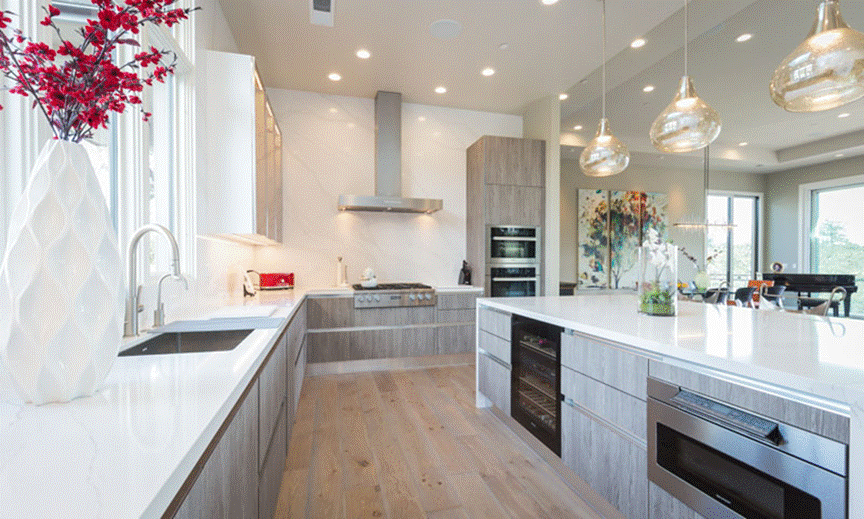
Waterfall edges, like those in the Sunnyvale, Los Altos and Mountain View photographs, are typically mitered so the veining carries around the corner. That affects how much material an island needs and how the slab is laid out, and the cabinet end panel and toe-kick need to be dimensioned for it. Edge profile changes how the top meets the cabinet. Bay StoneWorks’ estimate form lists straight beveled, eased, bullnose, ogee, demi bullnose and mitered edges, and a thick mitered edge against a handleless front looks very different from a bullnose. Seating overhangs also need structural support, which depends on the material and thickness, so settle it between the cabinet design and the fabricator.
Stone countertops are typically templated once the cabinetry is installed, so cabinet dimensions and field conditions carry straight through to the template. Our process includes a house visit to finalize measurements, and sink, cooktop and faucet decisions need to be final before the template is made. Bay StoneWorks, based in San Jose, also helps with slab acquisition and cuts curved countertops on a five-axis saw.
What drives the cost of high end kitchen countertops
Where a surface falls on the price scale depends on the specific stone or quartz line, so neither material is automatically the more or less expensive choice. The total also depends on the size and usable yield of the slabs, thickness, edge profile, waterfall details, seams and pattern matching, cutouts, backsplash, curved shapes and installation access, alongside the cabinetry, appliances, customization and project scope. Every ECDS client receives an itemized quote, with products and installation priced separately, so each part of the project is visible.
How to Decide Between Quartz and Natural Stone
Three questions usually settle it. How hard will the kitchen be used? Should the surface lead or support the cabinetry? And how much upkeep are you comfortable with?
You can compare surfaces next to cabinet finishes at our Palo Alto showroom, 864 San Antonio Rd. Our custom countertops page lists Caesarstone, Silestone, Cambria and Dekton on display, with Eurostone and Neolith also offered, and describes custom fabrication in quartz and natural stone. Current showroom hours are on our contact page. To talk through your project, you can book a design consultation.
Frequently asked questions
Can I use quartz and natural stone in the same kitchen?
Yes. Some kitchens use a statement slab on the island and a calmer surface elsewhere, and others use one material throughout. If you mix, check that the undertones and finishes sit well together, since a polished top beside a honed one is noticeable. Which surface goes in the heaviest work zone is worth deciding based on how you cook.
When should I decide between quartz and natural stone?
While the cabinet design is still being drawn. Slab dimensions, seams, waterfall edges, overhangs and cutouts all feed back into the cabinet drawings, so the surface and the edge detail are easier to settle early than to adapt around finished cabinets. You do not need a final slab at that point, but the type of surface and the approach to the island and edges help the cabinet drawings come out right. Our article on kitchen remodeling mistakes to avoid before ordering Italian cabinets explains why early decisions matter.